

Rubber Grips as Your Training Partner – When They Work Best and Why You Should Always Bring Two Pairs
For many CrossFitters, gymnasts and strength athletes, grips are as essential as shoes or a lifting belt. But not all grips are the same – and the material matters more than many people think. In this blog we look at why rubber-surfaced grips like the LEAGUE Elite are the first choice for many athletes, why they aren't the best option for gymnastic rings, and why your gym bag should hold more than one pair for different situations.
Why Choose Rubber Grips?
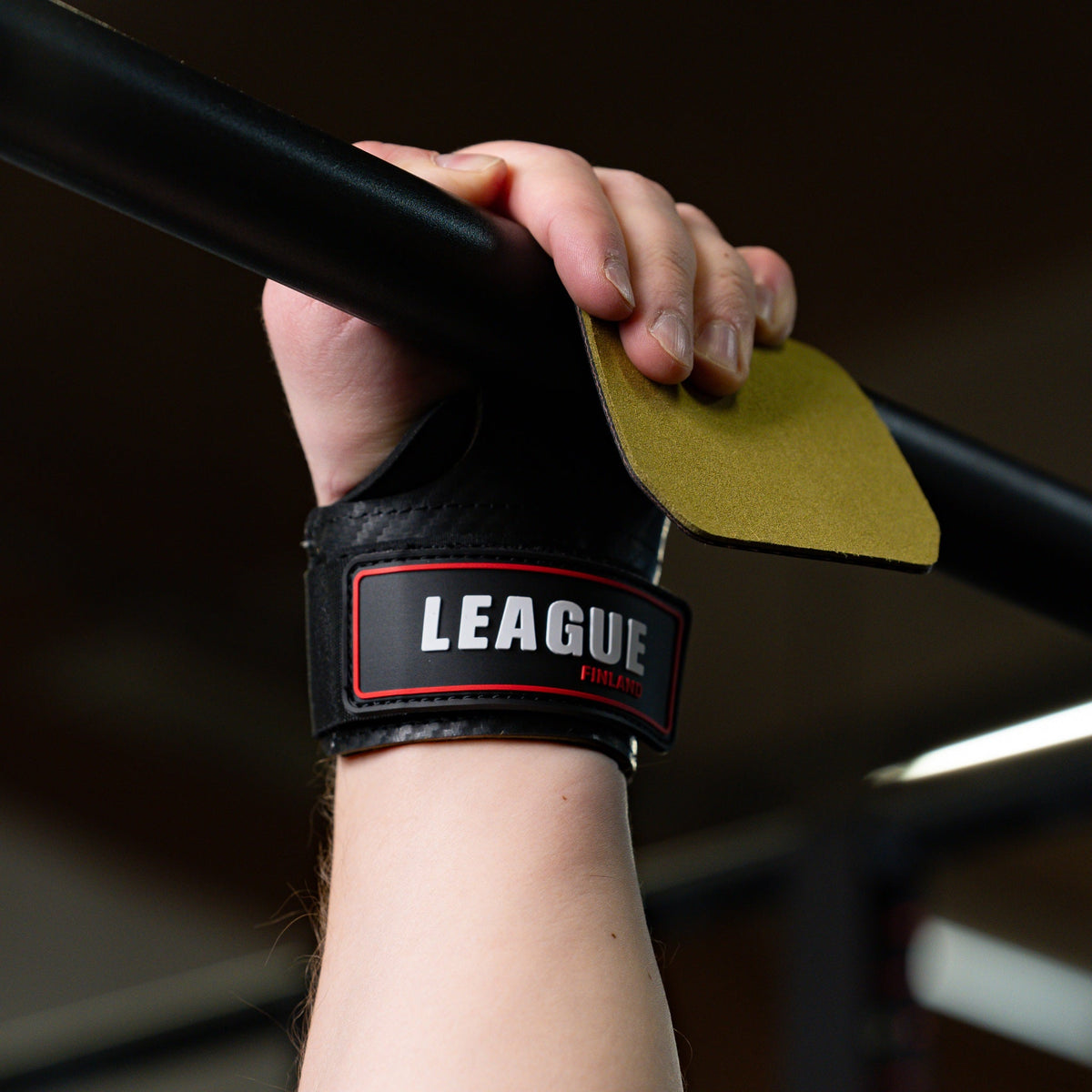
Rubber-surfaced grips have become especially popular in competition, and the reason is simple: grip. Rubber sticks to the bar far better than leather or synthetic materials, which means a more secure hold in bar movements such as pull-ups and muscle-ups.
Other benefits:
- Excellent grip even on smooth bars – rubber compensates for slipperiness better than other materials.
- Durability – a high-quality rubber surface combined with, for example, an aramid fibre layer (as in all LEAGUE rubber grips) withstands hard, repeated wear.
- No need for chalk – rubber grips work best just as they are, on a clean bar. This makes them popular in competitions or training settings where chalk use is often restricted or not allowed at all.
- Consistent feel – the rubber surface gives a predictable, uniform grip from one movement to the next.
That's exactly why many competitive athletes prefer rubber grips in CrossFit competitions, for example: the grip stays good without any extra aids, and the grips perform reliably even when your hands are sweating.
In the League Finland range, the best rubber-surfaced grips for a clean bar are the Elite and Elite Pro models – designed specifically for maximum grip without chalk. If you want one pair that adapts from one situation to another, Stealth is the most versatile option in the range.
Why Aren't Rubber Grips the Best Choice for Gymnastic Rings?
Although rubber grips shine on the bar, they aren't the ideal choice on gymnastic rings – and there are a few good reasons why:
1. Too much grip can be a drawback. Ring movements like kips, dips and muscle-ups often require the hand to rotate and slide within the grip in a controlled way. Rubber's strong adhesion prevents this natural movement, which can cause your palm to "stick" at the wrong point in the range of motion.
2. Rings move differently from a bar. A bar stays still, but rings swing and rotate during the movement. A rubber surface designed to maximise friction against a fixed surface doesn't let your hand adapt to the ring's rotation as smoothly as leather or synthetic material does.
3. Higher risk of joint strain. When your grip "sticks" too tightly in the middle of a rotating movement, abnormal torque can hit your wrist and elbow. That's one reason many gymnasts and ring specialists prefer a smoother or more flexible material on the rings.
In short: rubber grips are brilliant wherever you need maximum grip against a fixed surface – but on rings, a leather or synthetic grip that allows controlled sliding is often the better choice. In the League Finland range, Comfy, for example, is an excellent choice for rings thanks to its design.
Why Should You Have at Least Two Pairs of Grips in Your Bag?
This is something many people overlook: one pair of grips isn't enough for every situation.
In practice, workouts and competitions vary a lot – sometimes you train on a clean bar, sometimes with chalk, and sometimes you're in a situation where chalk isn't allowed at all. That's why it pays to carry two different pairs:
Pair 1: Grips that work with chalk Leather or synthetic grips (e.g. carbon material) work excellently with chalk. Chalk improves their grip even further and helps manage sweat during long or heavy sets. In the League Finland range, the Comfy and RX models are great for this. Comfy also has a surface that becomes even grippier when it gets slightly damp with chalk – making it an excellent choice for the sweatiest workouts. Comfy's design also makes it a great choice for rings.
Pair 2: Rubber grips without chalk Rubber grips give the best grip on a clean bar. In many competitions chalk is either banned or strictly limited – that's when rubber grips are the superior choice, because they don't rely on any aid to stay effective. The best options here are Elite and Elite Pro, or Stealth as a more versatile alternative.
With both pairs in your bag, you can adapt to the situation:
- Competition where chalk isn't allowed → Elite, Elite Pro or Stealth
- Heavy max set or the sweatiest workout where sweat is a problem → Comfy (grip improves when the surface gets slightly damp with chalk) or RX
- Ring movements → thanks to its design, Comfy is also excellent on rings
Summary
Grip material is no minor detail – it directly affects how safely and effectively you can train. Rubber grips like the LEAGUE Elite, Elite Pro and Stealth offer the best possible grip without chalk and are ideal for bar movements and competitions. On rings, however, choose a smoother material – and a second pair in your bag, such as Comfy or RX, which work excellently with chalk, makes sure you're ready for any training situation.
Explore the full League Finland grips range: league.fi/en/collections/lamsat
